




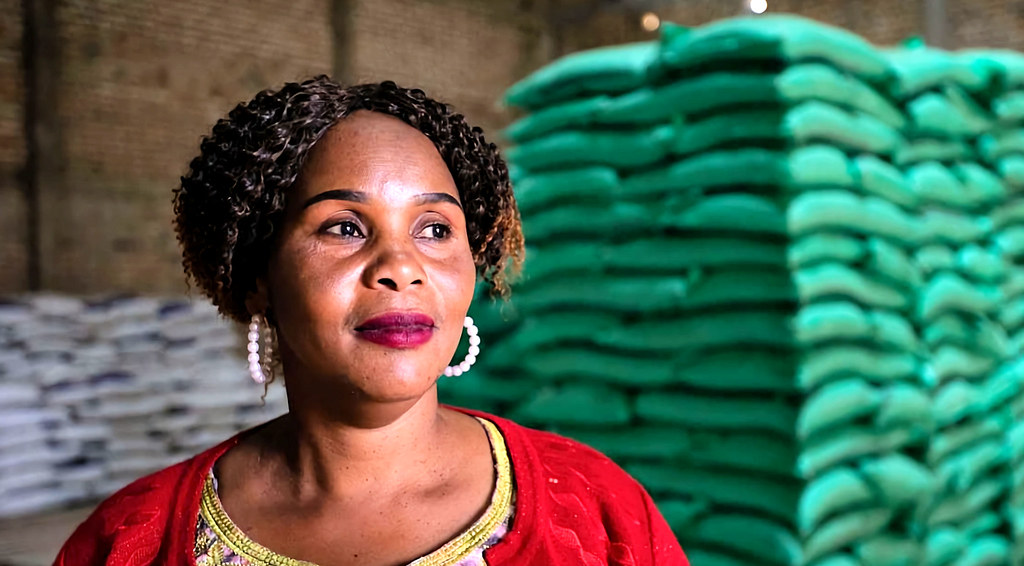
BAD: Businesswoman Thrives in “Male” Sector.
A loan guarantee from the African Development Bank (AfDB) helped Fideline Mahenge, a Tanzanian businesswoman, thrive in the traditionally male-dominated fertilizer sector. This compelling story was only possible thanks to the AfDB's ongoing support for women entrepreneurs and emerging entrepreneurs in Africa.
The story
As the morning mist rises over the rolling hills of Tanzania's Southern Highlands, Tumaini Kilawa walks carefully through the rows of his cabbages. Cabbage is a heavy feeder, quickly depleting the soil of necessary nutrients.
Tumaini often spreads fertilizer on his cabbage field to maximize production, as these additional nutrients are essential for his crops to grow.
In Tanzania, the agricultural system is characterized by dry lands and erratic rainfall, limiting productivity and contributing to land degradation, leaving smallholder farmers such as Tumaini vulnerable to various shocks.
Under these conditions, there is a need for optimal use of income drivers, particularly fertilizers, to mitigate farmers' losses and reduce poverty.
Fideline Mahenge, a local agricultural input distributor, also started its business in 2001.
“I was passionate about the agricultural inputs agency because I wanted to help farmers produce”.
“Here in Mafinga, 85% of the people are farmers, but the big challenge is the lack of agricultural inputs, particularly fertilizers”.
“So I started my business with small capital, but when I tried to reach out to different fertilizer suppliers, they couldn't support me”.
“Due to my small capital, they didn't trust me,” Fideline added.
The difficulties
Fertilizers and other agricultural inputs are distributed throughout the country through distribution centers and rural agro-dealers. For this system to work, fertilizer companies must provide a distribution network on time and in sufficient quantities.
But many of the companies have been reluctant to do business with agro-traders, who are often considered creditworthy. Many companies prefer distributors who pay cash or who have bank guarantees to back up their purchases.
But with high interest rates on bank loans, many agro-traders are unable to mobilize the adequate funds needed to meet the growing needs of farmers and due to declining profits, the number of agro-traders has also declined over the years.
The solution via BAD
In that sense, and to ensure that Tumaini and his partner, as well as many others, had access to much-needed fertilizers, from the factory to the farm gate.
AfDB and a local implementing partner created a $2,4 million credit guarantee facility under the African Fertilizer Finance Facility.
The intervention of the Africa Fertilizer Finance Facility encouraged suppliers and agro-traders to sign agricultural partnership contracts, paving the way for stronger relationships along the entire agricultural value chain. Under this scheme, more than 57.000 tonnes of fertilizer worth US$26 million have been traded to date.
In addition to promoting a trusting business environment with credit guarantees, the AfDB project also helped to improve the business skills of agro-dealers in the distribution center, who received training in business management with a focus on working capital, stock management, maintenance of records, and social and environmental safeguards.
Conclusion
Farmers' quick access to fertilizer is improving Tanzania's agricultural value chain. For agro-traders like Fideline, the improvements have been palpable and it managed to supply around 12.000 farmers in 2022 and now employs nine young people in Mafinga. The AfDB's support was vital for this.
What do you think of these types of support for small traders in the agricultural sector? Is it important for the AfDB to take more actions of this type? We want to know your opinion, do not hesitate to comment and if you liked the article, share and give a “like/like”.
See also:
AFAWA and BuyFromWomen support women farmers
Picture: © 2022 AFDB

